Five People We Might Recognize in the Mirror

Several years ago, I found myself frustrated by the story of Barabbas, the murderer who is given the freedom Jesus deserved. Certainly, I knew the cross is the path Jesus had to take to provide salvation, but the clear and total injustice of that moment left me stunned.

This year, reading through the Gospels, I found myself stunned again. How could so many people miss the fact that Jesus was the Messiah, and even those who did get it—Peter, for instance—blew it big time…

It’s at the height of my frustration that God brought the stinging blow to my pride: “You are each and every one of these apart from me.”

I’ve been Pilate— the man who believes he’s free from guilt. Confident in my own self-righteousness.

I’ve been the crowd—the people whose works put Jesus on the cross. In rebellion to what is clearly just and good, I enjoyed my own path, and it’s for my sin that he died on that tree.

I’ve been Judas and Peter—the men who walked closely with Jesus for so many years, yet in moments of great pressure and temptation, I falter in my faithfulness.

But praise God…

I am Barabbas—the man who deserves the highest punishment of all, but by the purposeful and gracious sacrifice of Jesus, I’m a man he came to save.


Just like everyone of the people in this story, we deserve condemnation. But the glorious truth of Easter is that Jesus came to take that condemnation on the cross, that we might live by the same power that raised him from the dead.

Yes, it’s offensive to recognize in ourselves the people who put Jesus on the cross. But it’s acceptance of that offense that leads us to enjoy the life Jesus came to give.

God did not send his Son into the world to condemn the world, but in order that the world might be saved through him. Whoever believes in him is not condemned, but whoever does not believe is condemned already.
-John 3:17-18

The Law and the Paradox of Grace

After God reveals himself to Moses, He seeks to free Israel from their slavery and suffering by sending plague after plague upon Egypt until Pharaoh lets the them go. Moses leads the people into the wilderness on the way to the promise land, and they come to Mt. Sinai where a huge part of the Biblical storyline takes place: the giving of the Ten Commandments.

Most people have heard of the ten commandments, and many can probably name quite a few of them. But what implications do they have for us today? Aren’t they a bit simplistic? Do they have any relevance for us today?

Certainly, they are a summary of the law of God, and they don’t answer every moral dilemma we may face. However, there is much we gain by looking to the law of God both in the ten commandments and the rest of Scripture.

First, the law of God reveals his holiness and what he values. We learn that God values his relationship with us: we’re called to only worship him. Then, we learn he values human life: we’re told not to kill. Ultimately, the law shows us his goodness.

Second, the law shows us what it looks like to live holy lives and honor God.

But then it also reveals our sinfulness and our need for mercy and grace. None of us live up to this standard, and looking to the law will only bring pain and shame (that is, unless we are unwilling to see how far short we fall). The law of God shows us our need for what Jesus did on the cross, and that’s why Paul says it’s good in Romans 7.

We need to feel the pain of our sin or we will never fully appreciate the grace Jesus offers us on the cross. This is the paradox of grace that Rudolph Bultmann describes here: “This paradox of the revelation, that in order to bring grace, it must also give offense, and so can turn to judgment. In order to be grace it must uncover sin; he who resists this binds himself to his sin, and so through the revelation, sin for the first time becomes definitive.”

When we see our sinfulness in light of the law, we can truly come to see how great God’s grace is toward us.

May we look to the law that we might rejoice in grace!

Suffering & the Burning Bush

Continuing through the story of Scripture, we’ve come to Moses and the burning bush. Yes, we did just skip about forty chapters of Genesis and went from Abraham beginning his journey to the promised land to about 400 years later in Egypt. It’s a long story, but basically, Abraham’s offspring eventually went to Egypt to survive a famine and stayed there. They grew to be the size of a small nation and were eventually enslaved by the Egyptians. And that’s where we find ourselves now.

Moses, an Israelite, has fled Egypt for the sake of his life and left behind his suffering people.

Suddenly, his life is turned upside down when he encounters a burning bush that’s not being destroyed. Many people reading this have probably heard this story 100 times growing up.

Unfortunately, we often miss the comforting message God is giving to us in our suffering through this story.

Three Truths about God that Sustain Us in Suffering

1. God hears us in our suffering (Exodus 2:23-3:7)

The people of Israel cry out to God in their suffering. I imagine many of their cries are out of frustration, anguish, and even doubt. They were likely struggling to believe the promises that were made hundreds of years ago to Abraham. Whether they had great or little faith, God heard their cry, and when He hears His people’s prayers, He responds for their good.

We can count on this promise, too. Jesus makes this abundantly clear in Matthew 7:7-11, for our God is a good Father who will give good gifts to his children. Will you cry to Him in your suffering?

2. God knows our suffering (Exodus 2:25 & 3:8)

But God doesn’t just hear our prayers about our suffering from some far removed location. He knows our suffering, not just intellectually like I know the score of last night’s Knicks’ loss (I would say game, but really, I’m pretty sure I can count on a loss no matter what day you’re reading this).

Anyway, God knows our suffering because He has suffered. The Father knew he would send Jesus to suffer on the cross, and that pained him even 1500 years before it happened. Our God is not one who can’t understand our pain, but he can relate to us in every hurt and temptation we could possibly experience (Hebrews 2:17-18 & 4:15-16).

Draw near to the God who understands perfectly the pain you are enduring.

3. God remains with us in our suffering (Exodus 3:8-15)

Finally, God reveals his great name to Moses in Exodus 3:14: “I AM WHO I AM.” This name, though pretty cryptic at first glance, communicates that God will always remain who He is: good, perfect, and true to his word. It also expresses the idea that He will remain with his people no matter what. These are huge promises for those who are suffering. We have a God we can count on, who will never fail us, and who has proven himself time and again through His Word.

If you’re suffering, remember that God hears, knows, and remains with you in your suffering. Be real in your cry to Him, and trust in His unchanging grace.

Deterred Faith- Three Types

After the flood and Noah’s salvation, man begins almost immediately to seek his own way again by making a name for himself through building the Tower of Babel. Once again, though, we find God making good on His purposes and promises despite humanity’s stubborn sinfulness. This time God calls and makes a covenant with Abram (Abraham), for it’s him through whom God will create a people for Himself.

So much can be said about Abraham. His faith is an incredible example of trusting and following God.

But it’s Abraham’s father that has captured my attention as of late: Terah.

You’ve probably never heard of this guy, but right before God’s covenant promise to Abraham in Genesis 12, we have a few short verses about Terah.

Abraham and Terah stand in stark contrast to one another. One has persevering faith and another deterred faith (or a lack thereof).

What is easy to miss is that Abraham’s call and promise from God in 12:1-5 is given to him prior to Terah moving with Abraham to the city of Haran. Other places in Scripture help us in this. For instance, in Acts 7:2, we learn that God spoke this promise to Abraham while he was still in his hometown before he had moved to Haran.

So it seems that originally Terah was going on this journey of faith with Abraham. But while Abraham would persevere, Terah would be deterred.

We can’t know exactly why Terah was deterred. It’s possible that settling down and building wealth was part of it since 12:5 says the family had gathered possessions in Haran. But we can’t know for sure. Ultimately, what is held up in this passage and over the next few chapters is a faith that perseveres, a faith that lasts, that trusts God through thick and thin, and that follows God where he calls.

So what can deter our faith and hinder us from persevering?

Here’s three types of people with deterred faith:

1. The Comfortable – The security, peace, happiness, and comfort that the world offers is constant before our eyes. We will always be tempted to settle in and just enjoy the comforts that we can accumulate in this life. Building our own little kingdoms of material wealth and security may provide temporary pleasure or peace, but it will always fall short of the promises God has given us as we follow him to uncomfortable places. How has your faith been deterred by the temptation to be comfortable where you currently are?

2. The Distracted – Like Dory from Finding Nemo, we can often become distracted by every cool new opportunity that comes our way. Rather than focusing in on the pursuit(s) God has for us, we are constantly changing directions. These are often good things we go after, but are they the best? What is distracting you from God’s call on your life and how do you need to focus?

3. The Oblivious – Another way we end up with deterred faith is by simply being oblivious. As far as we know, Terah never heard a call from the Lord directly, so he likely never owned the call. He was blind or oblivious to the richness of the promise he could partake in through the journey with Abraham. Are you just following another person’s lead, or are you following God’s voice as he leads and guides you through his Word? Are you walking with God personally on this journey of faith, or have you never experienced God personally and know his voice in your life?

**Even if you don’t know the specifics of God’s call for your life, you can pursue his clear calling on every believer’s life that is laid out in Scripture.

Which one are you?

Avoid each of these, trust in God’s promises, and follow him as he leads each of us to take up our cross daily.

DOUBLE RAINBOWS!!! – Are You Freaking Out Over God’s Grace?

About five years ago, a man shared a video via youtube of his experience viewing an incredible full double rainbow at Yosemite National Park. It went viral…

He was FREAKING OUT over this double rainbow! He was absolutely stunned with wonder and joy at its sight. Back and forth between tears and laughter, he marinated in the beauty of it all.

Check it out:

Screen Shot 2015-02-05 at 5.34.05 PM

Rainbows should stun Christians in a similar way. But we’ll get to why that is in a moment. First, we’ve got to reconnect with the story we’ve been following the past two weeks.

Genesis 1-3 showed God’s power and goodness in creation and man’s original sin that corrupted it all. Just a few short chapters later in Genesis 6, sin had multiplied exponentially, and rather than God’s glory filling the earth through mankind, evil filled the earth.

God was grieved by the brokenness and evil that had consumed his creation, and he would have been just to completely destroy this world full of evil. Yet while God does judge the world through a flood beyond any proportions we can imagine, He makes a covenant with Noah to make clear that his purposes and promises made in Genesis 1-3 will not fail.

In Genesis 6-9, we see God’s grief over evil and it’s destructive influence in the world. His grief leads him to shorten man’s life in order to inhibit the growth of evil, and it ultimately leads him to justly judge the evil before Him. In these dark chapters of destruction, we must realize that God did not delight in the destruction. He mourned for his creation.

Yet we also see that God sustains his promises and purposes despite our incredible failures. In verse 8, God declares that Noah had found favor in his eyes, but what does that mean? Had Noah been righteous when everyone else had not? Had he earned a free pass through the flood?

No, just one verse later (v. 9), Noah is described as walking with God. The idea of walking with God in the first chapters of the Bible carries with it the idea of faith and relationship. Noah was not saved from the flood because of his good works compared to others, but he was rescued because God saves us from sin by grace through faith (Eph. 2:8).

WHAT INCREDIBLE GRACE! While the rest of the world was being destroyed because of sin, God saved Noah because of grace. And to wrap it all up, he provided him with a reminder of that grace and his enduring promises and purposes: rainbows.

We should freak out when we see a rainbow, too! It’s a picture of God’s grace toward us, a reminder that his purposes do not fail, and a means for strengthening our confidence in his promises.

When was the last time you were in awestruck wonder at God’s grace?

May we be stunned by the evidences of God’s grace in our lives!

What Just Happened?!?

Every good story needs a problem, right? Well, the Bible doesn’t take long to get right to the crux of things. After such a good start, everything seems to fall apart in one fell swoop.

In Genesis 1-2, we see a beautiful, good creation cared for by the powerful, yet personal God of the universe. Beginning in chapter three, everything goes wrong. The one boundary God set for humanity is questioned and undercut by the serpent, and Adam and Eve embrace the lie and seek to be like God—incredibly foolish considering they had already been created in the image and likeness of God. The boundaries were for their good, and having crossed them, the first couple experienced the tragic consequences that we still feel today.

Let’s briefly look at three things we learn from this passage:

1. The nature of temptation
Temptation strikes at our belief in God’s goodness. When we are tempted, we begin to question whether God’s Word is actually intended for our good. This is what happens to Eve. The serpent convinces her that God is forbidding something for no good reason. How often do we fall into that trap?

Our society constantly questions the validity of God’s commands in Scripture. For instance, God makes clear that sex outside of marriage is sin and outside of his plan for us. But how often are arguments made that “making sure you are sexually compatible is important,” or “if I know I’ll be with this person for the rest of my life, then why wait for something that is good?” These objections are questioning the goodness and validity of God’s command. Temptation leads us to ask “Is it really that big of a deal?” Sometimes, it may be hard for us to see why it is, but if we really believe in the goodness of God, then we’ll trust his Word and flee temptation.

In what ways are you doubting God’s goodness in your life right now?

2. Our Reaction to Sin
What happens when we do sin? First, our reaction to sin, especially when we recognize the wrong, is a fleeing from relationships. Sin breaks our relationship with each other and God. As Adam and Eve, we feel shame and guilt, and we begin to experience a breaking of life-giving relationships. We begin to hide parts of ourselves from others, and as the level of authenticity breaks down, our relationships slowly become less and less meaningful. The community we were meant to experience erodes.

Additionally, we begin to flee from God. We don’t want to encounter his Word because we don’t want our sin exposed. We want to hide it from both God’s and our own eyes. So our relationship with Him breaks down.

3. The Response of God
Yet, the truth is, God sees our sin despite our best efforts to hide it, and He justly punishes it as we see in this passage.

But the incredible truth is that He also shows grace. Even in the midst of harsh consequences, God sows seeds of hope and grace. He points toward the promised Savior, who will crush the serpent’s head, ultimately destroying evil and sin. Then he provides a covering for the shame of Adam and Eve. God knows we can’t cover or remove our guilt and shame, so he made a way to wipe away our wrongs. Jesus came and lived the perfect life we were all created for, and then he died to take on the punishment we all deserved. Even in this terribly dark turn in the story, God has sown seeds of light and life!

How is sin breaking down relationships in your life? Do you have a broken relationship with God? If so, admit your sin to Him and trust in his grace that he has given once and for all through Jesus’ work on the cross

***Another Big Question: If God is good and created all things good (as is seen in Genesis 1), why is there so much evil and suffering in the world? Here are two short articles that begin to address that issue:

     –Do Tummy Aches Disprove God by Joe Carter
     –When Atheists are Angry at God by Joe Carter
     -Also, you can check out The Problem of Pain by CS Lewis here.

In the Beginning, God…

Throughout 2015, we are reading through Scripture together as a church in order to capture the whole, unified story. God used about 40 authors over hundreds of years to give us the story of his work of our redemption. Through the story, God shows us who He is and how we can relate to Him for His glory and our good. So we need to know the story, but we can’t stop there. We must also live the story, for we have been invited to experience the reality of these truths in our lives. Finally, we are called to share the story, so that others can experience God’s grace, too.

As small groups, we are going to dive into significant plot points throughout this story. This spring we are going to look at the Old Testament: God’s story of redemption. In the fall, we will study the New Testament by looking at the story of our redeemer and the story of the redeemed.


Every good story has a beginning, and for this one, we go to Genesis 1-2: “In the beginning, God…”

The story begins with God. – He is the central figure and author himself.

-The story doesn’t begin with us: humanity. We aren’t the main character, God is. Certainly, humanity is important, but the story begins with God to show us that He is the only all-sufficient, eternally existing being. This undermines our innate tendency to view the world as centered around us: our needs, our opinions, or our desires.

-A scientific explanation of creation is not the primary goal of these chapters. Wrestling with how current scientific evidence and Genesis 1-2 mesh is a valid pursuit (and many faithful believers disagree on this subject), but if this is where we focus, we’ve missed the point.

-Through the story of creation, God shows himself to be:

  1. Creator – 1:1
  2. Above and beyond all creation – 1:1-31 (Transcendent)
  3. The origin of all things good – 1:10, 12, 18, 25, 31
  4. The Giver of purpose – 1:27-28
  5. Personally involved with his creation – 2:7, 15-24 (Immanent)

***These truths are meant to give us hope in the midst of the chaotic world around us. How does God’s power, goodness, and personal nature change the way you look at a difficult situation in your life right now?

Humanity is unique in God’s creation. – The story may begin and center upon God, but humanity is clearly a special part of God’s creation and God’s story in the Bible.

-God makes us in His image. What in the world does that mean? Does that mean we look like God?

-No, not if we are talking about a physical likeness, for God is Spirit (John 4:24). Being made in the image of God means we reflect who God is through our purpose, characteristics, and relationships.

  1. Purpose – We’re called to “multiply and fill the earth” because God’s ultimate purpose is the spreading of His glory, and as people who reflect who He is, we spread his glory as we fill the earth. Also, as God reigns over all of His creation, we are given the responsibility to reign over creation (1:26-28). We are to do so with the same love, grace, and compassion as God.
  2. Characteristics – We have been created with creative, rational, and moral capacities that reflect God’s creativity, knowledge, and holiness.
  3. Relationships – “In the image of God he created him; male and female he created them.” When God created humanity in his image, He made us in relationship with both Himself and each other. It wasn’t good for the man to be alone. Apart from relationship with others, the man was unable to fully reflect God because God has always existed in relationship as the Trinity (Father, Son, and Holy Spirit).

So why is this important? Because as image bearers, our work, especially as it builds up society in a way that honors God, reflects God and fulfills our purpose as human beings. Our creative endeavors, our pursuit of better understanding of the world around us, and our pursuit of justice and mercy reflect who God is for His glory. And even our relationships are given a new life and purpose as they are meant for more than our mere pleasure.

***The drive to pursue these things is good, but as we will see next week, they are often out of whack because of sin. So pursue these things for God’s glory by relying upon God’s grace in Jesus.

The Most Important Thing About Us

The one book outside of Scripture that has most profoundly impacted me is A.W. Tozer’s Knowledge of the Holy. He begins his work with this:
What comes into our minds when we think about God is the most important thing about us.
Tozer’s right. In Proverbs, we see—again and again—an emphasis on the fear of the Lord. It’s the beginning of wisdom (9:10), our source of strong confidence (14:26), and our fountain of life (14:27). Each of these begin with a proper view of God that results in a fear of the Lord.

Continue reading

Christmas: A Message of Joy and Peace

Few times throughout the year in NYC evoke a unified theme throughout this great metropolis. Such diversity that exists throughout our city provides a constant flow of variety. But it’s as a result of this rich diversity—certainly something to be celebrated—that the city experiences few events that impact almost everyone in the city. Even when hosting the Superbowl this past January, the city practically continued on like normal. But there are a few holidays and events that supersede much of this diversity. Memorializing 9/11 is certainly a somber example. On the other end of the spectrum, Halloween is basically a city-wide extravaganza—kids to adults of all ages.

One other holiday overtakes this city: Christmas.

Decorations have filled stores since just after Halloween. Midtown is covered in lights, trees, and ornaments. You can find Christmas trees for sale on practically every street corner. Everyone is brought into the cultural fervor around Christmas: Christians and non-Christians alike (although, there are certainly many who are celebrating other holidays this time of year).

As a result, we have a huge opportunity to easily bring the message of the Gospel into everyday conversations. Why?

The message of Christmas, the reason we celebrate, is a message of Joy and Peace.

The angels in Luke 2:8-21 clearly declare this message.

The message of a baby in a manger is one of eternal joy and peace. Sounds crazy, but it’s so true. When Jesus came his mission was to make a way out of the brokenness of this world, a way to reconciliation with our God, and thus, ultimately, a way to joy and satisfaction in God and who he made us to be.

He also came as a King to bring peace. He accomplished peace by the blood of the cross (see Ephesians 2:11-22). He made a way for peace between God and man and among humanity itself. He didn’t establish a political peace, but one day he will provide eternal and complete peace when he returns and makes all things new (Revelation 21).

During Christmas, everyone is talking about the holidays. People are talking about their traditions and asking others about theirs. We have an opportunity to share this message of joy and peace by asking simple questions that can spark conversations.. We can ask why Christmas is such a big deal? We can simply talk about our traditions and how Jesus is involved in those.

Take advantage of this season when people are connected to such a Christian event, and use conversations about Christmas as bridges to the Gospel.

The Story 2015

As we prepare for a new year, it’s a great time to refocus and develop a clear plan for reading Scripture. One of the most fruitful disciplines in my life is reading through the entirety of God’s Word. Seeing the entire story of Scripture come together as a whole can only happen as we read the Bible in its entirety.

Thus, this upcoming year at Gallery Church, we are going to read through the entire Bible together.

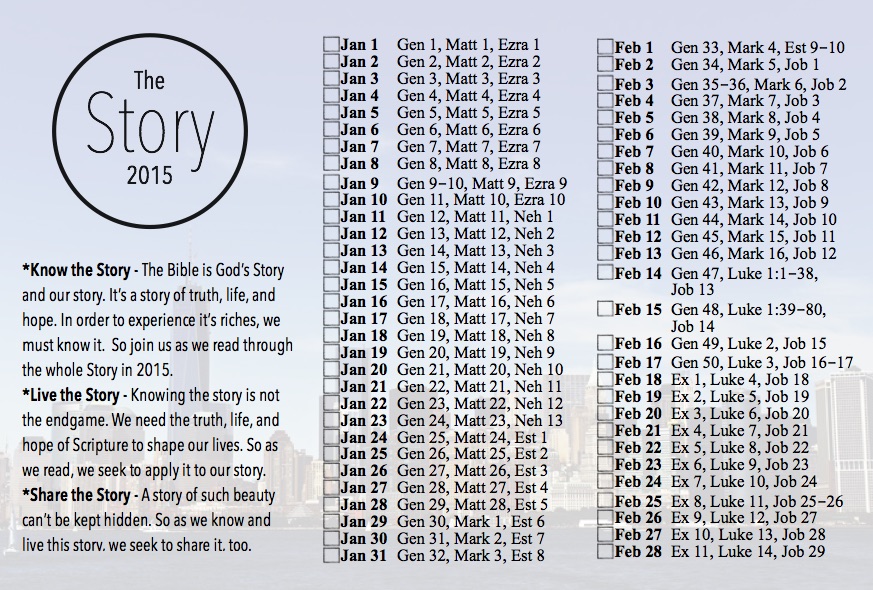
The Story 2015

Know the Story – 
The Bible is God’s Story and our story. It’s a story of truth, life, and hope. In order to experience it’s riches, we must know it.  So join us as we read through the whole Story in 2015.

Live the Story –
Knowing the story is not  the endgame. We need the truth, life, and hope of Scripture to shape our lives. So as we read, we seek to apply it to our story.

Share the Story –
A story of such beauty can’t be kept hidden. So as we know and live this story, we seek to share it, too.

Check out the first two months of the plan below:

Story Postcard