What Just Happened?!?

Every good story needs a problem, right? Well, the Bible doesn’t take long to get right to the crux of things. After such a good start, everything seems to fall apart in one fell swoop.

In Genesis 1-2, we see a beautiful, good creation cared for by the powerful, yet personal God of the universe. Beginning in chapter three, everything goes wrong. The one boundary God set for humanity is questioned and undercut by the serpent, and Adam and Eve embrace the lie and seek to be like God—incredibly foolish considering they had already been created in the image and likeness of God. The boundaries were for their good, and having crossed them, the first couple experienced the tragic consequences that we still feel today.

Let’s briefly look at three things we learn from this passage:

1. The nature of temptation
Temptation strikes at our belief in God’s goodness. When we are tempted, we begin to question whether God’s Word is actually intended for our good. This is what happens to Eve. The serpent convinces her that God is forbidding something for no good reason. How often do we fall into that trap?

Our society constantly questions the validity of God’s commands in Scripture. For instance, God makes clear that sex outside of marriage is sin and outside of his plan for us. But how often are arguments made that “making sure you are sexually compatible is important,” or “if I know I’ll be with this person for the rest of my life, then why wait for something that is good?” These objections are questioning the goodness and validity of God’s command. Temptation leads us to ask “Is it really that big of a deal?” Sometimes, it may be hard for us to see why it is, but if we really believe in the goodness of God, then we’ll trust his Word and flee temptation.

In what ways are you doubting God’s goodness in your life right now?

2. Our Reaction to Sin
What happens when we do sin? First, our reaction to sin, especially when we recognize the wrong, is a fleeing from relationships. Sin breaks our relationship with each other and God. As Adam and Eve, we feel shame and guilt, and we begin to experience a breaking of life-giving relationships. We begin to hide parts of ourselves from others, and as the level of authenticity breaks down, our relationships slowly become less and less meaningful. The community we were meant to experience erodes.

Additionally, we begin to flee from God. We don’t want to encounter his Word because we don’t want our sin exposed. We want to hide it from both God’s and our own eyes. So our relationship with Him breaks down.

3. The Response of God
Yet, the truth is, God sees our sin despite our best efforts to hide it, and He justly punishes it as we see in this passage.

But the incredible truth is that He also shows grace. Even in the midst of harsh consequences, God sows seeds of hope and grace. He points toward the promised Savior, who will crush the serpent’s head, ultimately destroying evil and sin. Then he provides a covering for the shame of Adam and Eve. God knows we can’t cover or remove our guilt and shame, so he made a way to wipe away our wrongs. Jesus came and lived the perfect life we were all created for, and then he died to take on the punishment we all deserved. Even in this terribly dark turn in the story, God has sown seeds of light and life!

How is sin breaking down relationships in your life? Do you have a broken relationship with God? If so, admit your sin to Him and trust in his grace that he has given once and for all through Jesus’ work on the cross

***Another Big Question: If God is good and created all things good (as is seen in Genesis 1), why is there so much evil and suffering in the world? Here are two short articles that begin to address that issue:
     –Do Tummy Aches Disprove God by Joe Carter
     –When Atheists are Angry at God by Joe Carter
     -Also, you can check out The Problem of Pain by CS Lewis here.

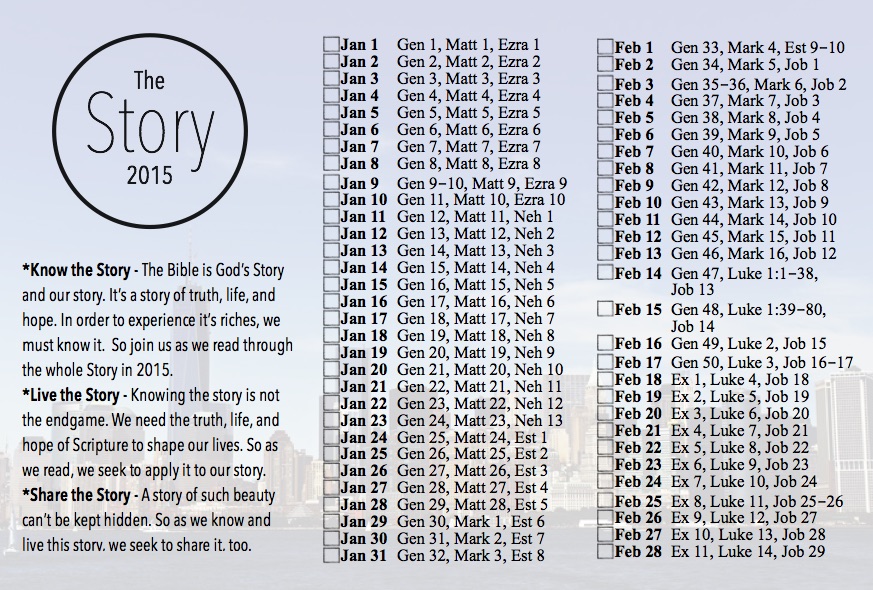
The Story 2015

As we prepare for a new year, it’s a great time to refocus and develop a clear plan for reading Scripture. One of the most fruitful disciplines in my life is reading through the entirety of God’s Word. Seeing the entire story of Scripture come together as a whole can only happen as we read the Bible in its entirety.

Thus, this upcoming year at Gallery Church, we are going to read through the entire Bible together.

The Story 2015

Know the Story – 
The Bible is God’s Story and our story. It’s a story of truth, life, and hope. In order to experience it’s riches, we must know it.  So join us as we read through the whole Story in 2015.

Live the Story –
Knowing the story is not  the endgame. We need the truth, life, and hope of Scripture to shape our lives. So as we read, we seek to apply it to our story.

Share the Story –
A story of such beauty can’t be kept hidden. So as we know and live this story, we seek to share it, too.

Check out the first two months of the plan below:

Story Postcard

Celebrating Christmas Well – Part II

Christmas is an incredible time of year. The hustle and bustle of Christmas shopping starting on Black Friday (well, maybe even earlier than that now), the vast arrays of decorations on seemingly every street, the ice skating in Central Park, the temporary Christmas markets set up at Union Square and Columbus circle, all add up to create a magical feel in NYC at this time of year. OK, maybe magical is a bit too much, but I simply LOVE Christmastime in this city. There are so many great traditions, and millions throughout the nation and the world celebrate this great holiday, each culture with their own unique twist to the celebration.

But how do we celebrate Christmas well? Without succumbing to a culture of materialism and covetousness?

The key to doing this lies in allowing this entire season to bring us to meditation upon and celebration of an absolutely crucial aspect of the Gospel: the humanity of Christ. I believe this is often a portion of the Gospel that is tragically under appreciated. And what better time than Christmas to invigorate and renew a passion for this essential truth!

The New Testament is full of references to the humanity of Christ, emphasizing the importance of this to the Gospel. 1 Timothy 3:15b-16 makes this incredibly clear:

which is the church of the living God,
a pillar and buttress of the truth.
Great indeed, we confess, is the mystery of godliness:

He was manifested in the flesh,
vindicated in the Spirit,
seen by angels,
proclaimed among the nations,
believed on in the world,
taken up in glory.

Paul sets forth a summary of God’s redemptive plan for humanity, i.e. the Gospel. This is the truth that the Church is to uphold, and very prominently at the beginning of this confession, the humanity of Christ is highlighted. But why is this truth so important to the Gospel, and why are we as the church called to protect this truth?

The Gospel Coalition’s Statement of faith provides several reasons that the humanity of Christ is essential to include:
“1.Christ as our model of true humanity– We realize from this that we weren’t meant for sin. Humanity is sinful because we have fallen not simply because we are human. Humanity was meant for so much more than this fallen world, and we see the image of God in humanity untainted in the person of Jesus. Christ in his humanity is what we were meant to be like.
2.Christ’s representative obedience– In Romans 5:18-19, Paul compares Adam’s representative sin that caused all of humanity to fall with the representative of Christ which provided all of humanity with the hope of being made righteous through His obedience.
3.Christ as our substitutionary sacrifice– Jesus had to be made like us in order to take our place and bear the wrath of God toward our sins. (Hebrews 2:17)
4.Christ as our mediator– Paul emphasizes Christ’s humanity when he discusses His mediatory role in 1 Timothy 2:5. Christ can stand in the gap between humanity and the Father because he has both a human and divine nature.
5.Christ as our sympathetic high priest– Jesus has experienced the hardships of humanity. (Hebrews 4:15-16)
6.Christ as our true example of holy human conduct– In Christ’s life we see what a truly holy life looks like. (1 Peter 2:21)”

Each of these without the humanity of Christ is lost, thus we must realize not only the great responsibility we have in guarding this truth but also the beauty of this truth.

We see the splendor of this truth lead Paul to worship in the short hymn of Philippians 2:5-11:
Make your own attitude that of Christ Jesus,

who existing in the form of God,
did not consider equality with God
as something to be used for his own advantage.
Instead He emptied himself
by assuming the form of a slave,
taking on the likeness of men.
And when he had come as a man in His external form,
he humbled himself by becoming obedient
 to the point of death—even death on a cross.
 For this reason God also highly exalted Him
 and gave Him the name that is above every name,
so that at the name of Jesus every knee should bow—
of those who are in heaven and on earth and under the earth—
and every tongue confess that Jesus Christ is Lord,
to the glory of God the Father.

Let us turn our celebrations and affections this Christmas season to this integral and beautiful aspect of the Gospel: the humanity of Christ. And let us, as His Church, defend this doctrine, for apart from this, the Gospel crumbles. If we are to redeem Christmas, we must simply celebrate the Gospel.

This doesn’t mean that we must toss out the cultural traditions, but instead, let us celebrate in such a way that our giving and receiving, family gatherings, and other traditions are expressions of our joy in Christ and in His grace, humility, and love that he showed by becoming human for our sake.

Celebrating Christmas Well – Part I

Outrageous amounts of family, friends, football and food is just a few days away. Certainly, Thanksgiving is a fantastic holiday all by itself. But, for me, it has always served primarily as the kickoff to the Christmas season. I mean, I think Macy’s gets it right when they send Santa down Central Park West at the end of the parade.

I’ll admit that I love the entire culture of the Christmas season, but Santa is not the reason we celebrate Christmas—Jesus is.

So as we approach the Christmas season, let’s commit to dwelling upon the real reason we celebrate: the birth of our Lord and Savior Jesus Christ.

Desiring God has produced a great devotional that I highly recommend for each of you this Christmas. It provides a reading for each day from December 1st-25th as well as a short devotional to read with it.

Focus your celebration of Christmas this year on the person of Jesus by following The Good New of Great Joy devotional.

Challenge: Show His Love to the World

There is no tangible resource to give this week. That’s not because there aren’t great resources available in abundance, but instead, it’s because each and every person who has faith in Jesus with the Spirit living inside them has what it takes to accomplish the theme for this week: love one another.

Instead of a resource, I’m giving a challenge to all my readers: Find one tangible way to love two people this week.

First, love another brother or sister in Christ by serving them, encouraging them, or even going old-fashioned and sending them a thank you note.

Second, love your neighbor. Find one person in your life who doesn’t know Jesus and clearly and tangibly show them the love of Jesus.

That’s your mission: Tangibly love two people this week.

Now go out and do it!

Know & Share the Gospel

We’ve been focusing a whole lot on sharing our faith lately. We can talk strategies and provide tools for sharing the Gospel all day long, but if we do not know the Gospel deep inside our hearts, then we will not be able to share the Gospel in a natural and contextually appropriate way.

So, this week’s resource is Tell the Truth by Will Metzger.

This is a heftier resource than normal, but it’s worth every moment of investment. Metzger not only provides a thorough explanation of the Gospel and common misconceptions, but he also provides great insights on how to share the Gospel as well. It’s a holistic resource for evangelism, and I can’t recommend it highly enough.

Check it out here.

Shaping & Sharing Your Story

On Monday, we considered the power of story both in our culture today and in the story of Paul in Acts 26. I encouraged everyone to consider how you would share your own personal story in order to communicate the Gospel. But many of you may be at a loss as to how to share your story in a clear way.

So, here’s a resource from InterVarsity. This tool provides questions to spark your thinking about how to shape and share your story. It hits the same basic plot points that I discussed on Monday: life before Jesus, how you met Jesus, life with Jesus.

Check it out if you need help shaping your story, and pay close attention to their advice at the end: Keep your story short so it’s easy to tell. You can always expand on something when people ask questions.

 30 Minutes to a Shareable Testimony Worksheet

The Story of the Gospel

Tracts often get a bad rap, and often, rightly so! But if you are looking for an easy to use tool that is also readily accessible to people in our digital age, then The Story is a great resource.

This short digital booklet summarizes the Gospel message well, and it looks good!

If you are in need of something to point people to who you may not get the opportunity to continue a conversation with or someone that may simply want something to mull over between conversations, then this resource is for you. Check it out by clicking the image below:

booklet

Scripture-Focused Discipleship

On Monday, I talked about the importance of studying Scripture as part of discipleship relationships. If you’ve ever led a Bible study, you may think that the thought of leading a study of a chapter of Scripture every week or two is a very daunting task. And if you’ve never led a Bible study, you may feel like you don’t even know where to begin.

Don’t worry. It’s not as intimidating as it may sound. Simply reading the Scripture and then asking specific questions is all you need. But what questions do you ask?
Discovery Bible Study is a simple method for leading a study of Scripture in discipleship groups by simply asking questions of the text and one another.

To get started leading a discipleship group, you can simply work through the DBS method. As you get more familiar with the gist of it, you will be more comfortable and able to lead without the guide in hand.

For now, check out these great Discovery Bible Study materials.

This is a great guide for leading a discipleship group that fits great into the model we’ve adopted at Gallery Church.

Beware of Community

“Whoever cannot be alone should beware of community…. Whoever cannot stand being in community should beware of being alone…. Each taken by itself has profound pitfalls and perils. Those who want community without solitude plunge into the void of words and feelings, and those who seek solitude without community perish in the bottomless pit of vanity, self-infatuation and despair.”

-Dietrich Bonhoeffer in Life Together (Fortress Press), 82-83.

This profound truth—the necessity of both solitude and community—infuses our discipleship with a healthy balance of both an individual and community pursuit. In a culture that loves the idea of community, we must avoid idolizing it. As we pursue intentional discipleship, we must recognize that Jesus uses both solitude and community to draw us closer to and increase our faith in Him.

For further reflection on Biblical community, check out all of Bonhoeffer’s Life Together.

download (1)