Jesus’ Example & Call to Prayer

After three years of teaching and ministry, Jesus begins the final preparations for the ultimate stage of his life and ministry: his death on the cross. This week we are looking at two evenings that lead up to cross, for these are significant turns in the story.

The focus here, though, will be on Jesus’ interaction with Peter in Matthew 26:30-46.

In the first six verses of this passage, Jesus once again explains what is about to happen: He is going to die and they are going to scatter for a time. But Peter in all his audacity declares, “I will never fall away.”

Unfortunately, Jesus gives Peter a harsh reality check when he explains that Peter will deny Him three times before the night is over.

Peter would have none of it. He adamantly responds, “I will not deny you!”

Jesus knew differently, but he continued with his disciples to Gethsemane where an important moment happens that gives us great insight into why Peter fell to the pressure of the hour as well.

Jesus invites Peter and two others to pray with him in the garden, but instead, they fall asleep. Jesus exhorts the disciples to “Watch and pray that you may not enter into temptation. The spirit indeed is willing; but the flesh is weak.”

Coming on the heels of the previous conversation with Peter, Jesus is clearly pointing to the Peter’s one hope of actually remaining true to Christ through the upcoming trials: prayer.

Jesus recognizes Peters passionate desire to be faithful to his Lord, but He also recognizes the immense power of the flesh. While he knows Peter won’t embrace the gift of prayer at this moment, He offers him this gracious gift anyway and shows him a perfect example of what this kind of prayer looks like. In doing so, He points us all to how we can prepare for sufferings, trials, and persecutions.

We are all going to face many of the same kinds of temptations to abandon our Lord. Whether it’s due to persecution from outside of us or desires from within, we will be faced with the temptation to place Christ aside. Apart from his grace and a constant dependence upon him in prayer, we will fall just as Peter did. Thankfully, just as Peter was joyfully welcomed back, we can be confident that Jesus will do the same for us as well. Though we may let go of Him, He will never let go of us!

May we pursue faithfulness at all times by being a people who rely upon the Spirit of God through prayer.
Jesus Preps for Mission

As we’ve been working through the story of Scripture over this past year, we now come to the New Testament. Since we last left off with prophets foretelling the coming of a Savior, the first chapters of Matthew share the miraculous birth story of the one they were foretelling: Jesus Christ. Now, we’re jumping ahead a few chapters into Jesus’ preparation for his mission.

In Matthew 3:13-4:11, we see Jesus baptized and tempted in the wilderness, and there’s a ton to learn from these passages. But three things stick out here that not only characterize Jesus’ life and ministry but should characterize ours as well.

1. Jesus gets his identity from the Father (3:17)

As Jesus emerges from being dunked the Jordan river, the Father declares His approval and His Sonship. We often read right past this as a simple truth about who Jesus is, but it’s this identity affirmed by the Father that gives Jesus the security to fight temptation, suffer persecution, undergo the torture of the cross, and ultimately die on that tree. Knowing he is God’s Son gives him the confidence to go wherever He leads, for he knows the Father will always work for the good of His children, especially His Son with whom he is well pleased.

The incredible thing is that in Jesus, we have the same identity and security. Unfortunately, the culture around us calls us to find our identity in so many other things: careers, relationships, success, etc. As a result, we experience fear, anxiety, anger, or insecurity. We need to follow our Savior and trust in the identity that he has given us through the Gospel by reminding ourselves of our adoption as children of God.

2. Jesus follows the direction of the Spirit (4:1)

Not only is finding our identity in God essential to life in this world, but Jesus also exhibits how we must be led by the Spirit. Jesus, as God himself, could have very well sought to do it all on his own, but instead, he followed the loving, gentle guidance of the Holy Spirit. And clearly, following the Spirit doesn’t mean we will always be led from one joyous, comfortable situation to the next. Jesus was led right into battle. But the Holy Spirit always leads to the good. In this case, Jesus was led to overcome temptation in the wilderness in contrast to the failure of our oldest parents: Adam and Eve.

Jesus sent us this same Spirit for our good, and it’s as we follow him into the difficult places that we will find life and victory just as Christ did. How do we do this? Primarily through the Word, prayer, and community, and it’s to the first of these that we now turn.

3. Jesus fights temptation with the Word (4:4, 7, 10)

The Holy Spirit led Jesus into battle, but it was a battle he was prepared for. Satan attacked with a variety of temptation that we all encounter in various forms throughout our lives: fame, success, power, etc. But Jesus overcame these strongest attacks even while at his weakest physically (He had just fasted 40 DAYS!!!), and he did this through the power of God’s Word.

If we hope to overcome temptation in our life and experience the fullness of abundant life that Jesus offers us right now, we must emulate him and know God’s Word so when we are faced with temptation, we have the means to overcome Satan’s lies with God’s truth.

May we be a people that emulate Christ for His fame and our good!

The Attitude, Source, and Security of the Wise

While Solomon is famous for building the temple, he is probably more famous for his wisdom. Everyone would recognize some of his writings in Proverbs like “iron sharpens iron.” Though not a narrative like much of what we’ve been looking at this year, Proverbs makes up a significant portion of the Old Testament wisdom literature. So as we walk through the Old Testament, we need to stop and consider the primary message of this book.

“The fear of the Lord is the beginning of knowledge; fools despise wisdom and instruction.” – Proverbs 1:7

“For the Lord gives wisdom; from his mouth come knowledge and understanding.” – Proverbs 2:6

“For wisdom will come into your heart, and knowledge will be pleasant to your soul; discretion will watch over you, understanding will guard you.” – Proverbs 2:10-11

“Trust in the Lord with all your heart, and do not lean on your own understanding.” – Proverbs 3:5

From this small sampling of Proverbs, we find three characteristics of the wise: their attitude, source, and security.

The Attitude –
The wise will fear the Lord. This isn’t a fear like we get from a horror movie, but rather a humble reverential awe and respect that we get when we view the power of a natural wonder like Niagara Falls. The wise will feel insignificant when looking upon the Lord. They will respect his power by not leaning on their own understanding but trusting in his direction.

Just as one follows the signs that the parks department puts up at Niagara Falls in order to avoid likely death from the falls, the wise listen to the words of the Lord trusting that He knows best even when we don’t understand. It’s tempting to question God’s Word when we don’t understand the reasoning for a specific command, but Solomon is encouraging us to trust in the Lord’s Word even while we are still seeking to understand the reasoning behind it.

The Source –
As is obvious from the previous section, the Lord is our primary source for wisdom. And Proverbs 2:1-11 makes clear that we have access to this wisdom through God’s Word in Scripture. So the wise seek to drink deeply from the well of wisdom that is God’s Word on a daily basis.

The Security –
Wisdom can help with a ton of aspects of life, but the promise God gives to the wise in this passage is that the wisdom that comes from him will guard our souls and deliver us from evil. The pinnacle of wisdom is found in the Gospel: we are messed up creatures with no hope while leaning on our own works or understanding, but through trusting God, we can find life. What a great hope! We have ultimate life and security through the person of wisdom: Jesus Christ (1 Corinthians 24, 30).

May we be a people of true wisdom, not the fading “wisdom” of the world.

Three Keys to Spiritual Renewal

Diving back into the Old Testament storyline this week, we find ourselves listening in on God’s words to Solomon after the dedication of the temple.

God knew his people would rebel and need to experience renewal, so he lays out the path to renewal in 2 Chronicles 7:14.

If my people who are called by my name humble themselves, and pray and seek my face and turn from their wicked ways, then I will hear from heaven and will forgive their sin and heal their land.

Prayer is the primary vehicle that God provides here for our spiritual renewal, for later he promises to hear our prayers. Yet, God calls us to a particular type of prayer. Prayer that is characterized by:

Reliance
We are tempted to work ourselves out of problems. Instead, we are called to begin with prayer, thus recognizing that we don’t have the solution in ourselves i.e. humbling ourselves. As a result, God gets the glory, not us. And we experience the renewal that comes from relying upon an all-sufficient God.

Right Relationship
We are tempted to relate wrongly to God: to feel entitled or to pursue other things as ultimate. But God wants us to commune with him, to seek his face, not because we think we deserve it and not because we want other things but because we long to relate to him. So we’re called to go to him in prayer out of a desire to know and be known by him.

Repentance
We are tempted to avoid acknowledging our sin, God’s holiness, and our need for him. Prayer brings us face to face with a holy God which brings our brokenness to light, too. Prayer that truly encounters God leads us to grapple with our sinfulness. Yet it doesn’t leave us in a broken state, for it’s in this repentance that God promises to bring renewal.

May these aspects characterize our prayer that we might experience renewal from our God.

***One last thing: don’t make the mistake of thinking this is always an individual pursuit. Sometimes the start of this process doesn’t begin by yourself before God, but by admitting your struggle to others (humbling yourself) so that they can seek God’s face for you when you feel too weak to do so. This is a huge part of why the church is so vital to our spiritual lives.

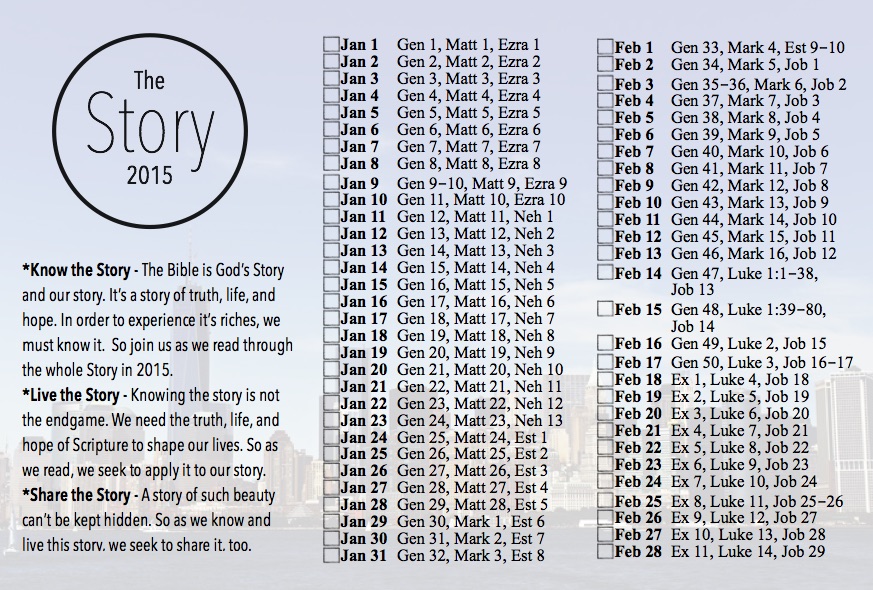
The Story 2015

As we prepare for a new year, it’s a great time to refocus and develop a clear plan for reading Scripture. One of the most fruitful disciplines in my life is reading through the entirety of God’s Word. Seeing the entire story of Scripture come together as a whole can only happen as we read the Bible in its entirety.

Thus, this upcoming year at Gallery Church, we are going to read through the entire Bible together.

The Story 2015

Know the Story – 
The Bible is God’s Story and our story. It’s a story of truth, life, and hope. In order to experience it’s riches, we must know it.  So join us as we read through the whole Story in 2015.

Live the Story –
Knowing the story is not  the endgame. We need the truth, life, and hope of Scripture to shape our lives. So as we read, we seek to apply it to our story.

Share the Story –
A story of such beauty can’t be kept hidden. So as we know and live this story, we seek to share it, too.

Check out the first two months of the plan below:

Story Postcard