Two Annoying Aspects of Prayer

I’ll admit it. Making a bold shameless ask and being persistent in it makes me highly uncomfortable. I’ve never wanted to be perceived as taking advantage of others, overstaying my welcome, or pursuing my own desires over others’. Most likely, I don’t like these things because I find them highly annoying in other people particularly when accompanied by entitlement.

Yet, shamelessness and persistence are two aspects of prayer that Jesus calls us to in the book of Luke.

First, Jesus shares a story of a friend in need:

And he said to them, “Which of you who has a friend will go to him at midnight and say to him, ‘Friend, lend me three loaves, for a friend of mine has arrived on a journey, and I have nothing to set before him’; and he will answer from within, ‘Do not bother me; the door is now shut, and my children are with me in bed. I cannot get up and give you anything’? I tell you, though he will not get up and give him anything because he is his friend, yet because of his impudence [bold shamelessness] he will rise and give him whatever he needs. And I tell you, ask, and it will be given to you; seek, and you will find; knock, and it will be opened to you. For everyone who asks receives, and the one who seeks finds, and to the one who knocks it will be opened. What father among you, if his son asks for a fish, will instead of a fish give him a serpent; or if he asks for an egg, will give him a scorpion? If you then, who are evil, know how to give good gifts to your children, how much more will the heavenly Father give the Holy Spirit to those who ask him!” – Luke 11:5-13

Shamelessness flows from childlike faith not entitled pride. The person in the story pursued his friend’s help because he knew his friend’s character: avoiding shame at all costs. As for us, we can boldly and shamelessly ask God for all our needs and desires when we have a childlike faith in His character as our loving, gracious, and merciful heavenly Father. We don’t seek answers because we’ve earned them but because He is gracious.

Prayer is not cashing a paycheck, but trusting in grace.

Second, Jesus shares a story of a persistent widow:

And he told them a parable to the effect that they ought always to pray and not lose heart. He said,“In a certain city there was a judge who neither feared God nor respected man. And there was a widow in that city who kept coming to him and saying, ‘Give me justice against my adversary.’ For a while he refused, but afterward he said to himself, ‘Though I neither fear God nor respect man, yet because this widow keeps bothering me, I will give her justice, so that she will not beat me down by her continual coming.’” And the Lord said, “Hear what the unrighteous judge says. And will not God give justice to his elect, who cry to him day and night? Will he delay long over them? I tell you, he will give justice to them speedily. Nevertheless, when the Son of Man comes, will he find faith on earth?” – Luke 18:1-8

Persistence flows from complete reliance not arrogant manipulation. The widow knew her only hope for justice was to go to the one who had the power to accomplish it. She recognized her powerlessness, embraced it, and relied completely upon the judge. She didn’t persist as some tactic to manipulate him, but out of her need for his grace. The same goes for our prayers to God.

Prayer is not a tool to manipulate God, but an exhibition of faith.

May we come to our heavenly Father as His sons and daughters with bold shamelessness and undying persistence and make our requests known to Him with expectant faith for how He will answer.
Praying More Than a Wish List

Last week, we considered how to build a habit of prayer, but if we don’t have a good pattern or rhythm to our prayers, then we will tend toward focusing on ourselves. If we aren’t careful, prayer can quickly become a wish list brought to a cosmic Santa Claus rather than a time of conversation with our God and Father. In sports, one practices drills over and over again to hone particular muscles and skills so that unnatural motions become natural and even automatic. Similar to athletics, we need some drills to develop the fundamentals of prayer. Here are a couple of helpful resources that will help you develop a holistic relationship with God through prayer:

A.C.T.S

A simple acronym can go a long way to help guide your prayer time and make sure you focus on more than simply making requests to God. Each time you spend with God in focused prayer. Work through the following aspects of conversation with God:

Adoration – Begin your time with God reflecting upon who He is and praising Him.

Confession – Next, consider who you are-a sinner saved by grace. Be authentic with God, confess your sin to him, and express your need for him.

Thanksgiving – Flow from your need for Him to thanksgiving to God for His provision of grace and salvation in Jesus. Then thank Him for the many other blessings in your life.

Supplication – Wrap up your time of prayer with requests for both yourself and others.

Face to Face by Ken Boa

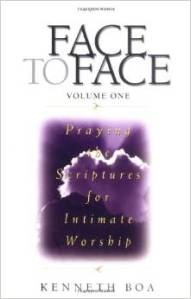
Another great tool for growing in your relationship with the Lord through prayer is learning to pray the Scriptures. Meditating upon God’s truth can go a long way toward expanding how and what you talk about to God. The best resource I have found and use on a regular basis is Face to Face: Praying the Scriptures for Intimate Worship by Ken Boa. It works through a similar rhythm of prayer as the A.C.T.S. paradigm above, but it also provides Scriptures to guide your thoughts and give voice to your prayers. You can buy it on Amazon by clicking on the image below:


Boa Image

A Pattern of Prayer

Prayer is not a practice that comes naturally. It didn’t for Jesus’ disciples, so why should we expect it to be so for us?

I’ve only been married for a little over a year, but one thing I’ve learned is that communication is going to be a lifelong learning process. I wasn’t born an expert at it and neither was my wife. We are constantly learning more about how to express ourselves fully to one another. One helpful tool for developing relational intimacy in marriage is learning to ask good questions in all areas of life. We did some of this when we went through premarital counseling, and it’s helpful to come back to those questions to make sure we are continuing to get to know each other more and more all the time. These questions don’t dry up our relationship, but instead, they breathe life into often ignored or forgotten areas of our relationship.

The same holds true for our conversations with God i.e. prayer. Reminders and guides aren’t meant to make our prayers rote, but instead, they have the potential to expand our knowledge of and relationship with God. And this expansion won’t happen naturally. We must learn and cultivate it.

This is why Jesus’ disciples asked him to teach them to pray, and as a result, Jesus provided us with the ultimate pattern for prayer and growing our conversations with God:

Father, hallowed be your name. Your Kingdom come. Give us each day our daily bread, and forgive us our sins, for we ourselves forgive everyone who is indebted to us. And lead us not into temptation.

-Luke 11:2-4

Jesus isn’t simply giving us the exact words we should pray over and over again. Rather, Jesus is giving us a pattern. He is providing a guide to remind us to address every aspect of our relationship with God in prayer. He points to at least three different aspects of prayer in this passage:

  1. Adoration – “Father, hallowed be your name.” This phrase is an acknowledgement and praise of God’s holiness.
  2. Confession – “Forgive us our sins.” This phrase is a moment of authenticity before God and a turning toward Him.
  3. Reliance & Request – “Give us each day our daily bread… And lead us not into temptation.” These two phrases highlight our deep reliance upon God and the humble requests for physical and spiritual provision from him.

Don’t expect to grow in your relationship with God apart from developing a holistic rhythm of communication with God. Commit to involving at least these three aspects in your prayer on a daily basis.

Let’s devote ourselves to prayer by modeling our communication on Jesus’ guide for prayer.

Gospel-Centered Prayer for Church-Wide Renewal

Strategies for church growth and revitalization line the walls of Christian book stores. The methods vary as much as the stories that highlight them. Pragmatism is king in our society, and pastors tend to fall prey to this along with everyone else. Despite this tendency, many of these books are legitimately helpful and provide inspiration and insights for ministry. This post isn’t meant to be a bashing of church growth material, for while the materials can be a mixed bag, much good can be gained when read with discernment. The major problem with church growth material is not the content itself but the reader. Strategies are useful and even needed, but if this is where we begin, we have failed from the outset.

Church revitalization begins on our knees in prayer.

Martin Luther understood this well: “If I fail to spend two hours in prayer each morning, the devil gets the victory through the day. I have so much business I cannot get on without spending three hours daily in prayer.”

But we know this not because I say this or Martin Luther claims it, but rather because God promises renewal if we pray.

If my people who are called by my name humble themselves,and pray and seek my face and turn from their wicked ways, then I will hear from heaven and will forgive their sin and heal their land.

-2 Chronicles 7:14

When our churches fail, when we stumble–even run–into sin, and when we grow cold in our love for Jesus, God calls us not to get to work but to come to Him. Why is it that we point people to grace for salvation and again as they fail individually, but when we are faced with a dying church that we immediately turn to the work we can do? God promises holistic renewal for our churches if we would devote ourselves to prayer not because our labor in prayer is a worthy work, but because prayer is a return to the Gospel.

2 Chronicles 7:14 clearly portrays God’s call to Gospel-centered prayer for the sake of renewal. Each act in this verse finds its beginning in prayer and gives us the clear shape of what our prayers should look like. Humbling ourselves begins with prayer to God exhibiting reliance upon him. Seeking God’s face begins with prayer that seeks a right relationship with God. Finally, turning from our wicked ways begins with prayer that turns our hearts toward God and away from sin.

Prayer is the most fundamental Gospel practice, and it’s the Gospel that is the power of God for salvation. As seen in this passage, prayer is fundamental because it exhibits three primary responses to the Gospel:

  1. Reliance – we admit and seek total reliance upon God.
  2. Right Relationship – we put idols aside and seek the face of God through the work of Christ.
  3. Repentance – we turn from sin by the grace of God.

So why does God call his people to prayer in order to experience renewal? Because biblical prayer drives us to meditate upon, experience, and practice the gospel in our lives.

Church revitalization begins on our knees in prayer. To begin anywhere else is to trust in something other than the Gospel. Will we devote ourselves to prayer or place our hopes in someone else?

Forming a Prayer Habit

During my small group this past week, we discussed the idea of forming habits. We reflected upon the general feeling that habits are so often viewed in a negative light. For many in the Church, we have reacted against legalism with a complete avoidance of habits, yet Scripture actually affirms some habits as good (see 1 Timothy 4:7-8; Hebrews 10:24). If any practice in Scripture is affirmed as worthy of developing a habit, it’s prayer. In fact, Paul so wants this habit to be built into our lives that he urges us to “pray without ceasing” (1 Thessalonians 5:17).

But how do we build such a constant habit of prayer? It seems like an impossible goal.

Think about this, though. A few days ago, my wife and I were on weekend trip to the Poconos, and we did a 25 mile bike ride, which got us thinking about Iron Man races. Basically, we talked about how impossible an Iron Man seems. Just imagine a 2.4 mile swim, 26.2 mile run, and 112 mile bike ride all in the same day! We couldn’t imagine how anyone could accomplish such a feat.

But people do it all the time.

How? Incremental training over a long period of time.

So how do we build toward praying constantly? We start small in two areas: focused planned prayer and triggered spontaneous prayer.

Focused planned prayer
Start by setting aside five minutes per day for prayer. While you can do this anywhere, I’d suggest finding a place in your home where you can be completely focused on talking to the Lord. Each week increase the amount of time you spend in prayer by 2-3 minutes. Don’t burn yourself out by starting out too long. Just like training for an Iron Man, you’ve got to build habits of prayer that increase over time.

Triggered spontaneous prayer
Set apart a couple of triggers in your mind to spark spontaneous prayer throughout your day. What are triggers? Specific places, times, events, people, etc. The key is to make your triggers something specific encountered on a daily basis. For instance, many people have a trigger already built in: meals. We sit down for a meal and pray before we eat. Other possibilities could be when you receive a text message, when you get on the subway or in your car, or when you do a specific task that is otherwise brainless. Brainstorm and identify a couple of triggers that will remind you to pray at various points throughout your day beyond your focused planned prayer time.

Commit to these two areas of prayer, and over time, a habit of prayer will be formed that will grow your relationship with the Lord and produce significant fruit in your life and others’.

Gospel-Centered Prayer

The focus of the next three weeks is prayer. To begin, we need to consider how our identity affects our prayer life.

How we perceive ourselves drastically affects our approach to God. Specifically, our identity is deeply intertwined with our approach to God in prayer. Jesus teaches just this truth in Luke 18:9-14.

He also told this parable to some who trusted in themselves that they were righteous, and treated others with contempt: “Two men went up into the temple to pray, one a Pharisee and the other a tax collector. The Pharisee, standing by himself, prayed thus: ‘God, I thank you that I am not like other men, extortioners, unjust, adulterers, or even like this tax collector. I fast twice a week; I give tithes of all that I get.’ But the tax collector, standing far off, would not even lift up his eyes to heaven, but beat his breast, saying, ‘God, be merciful to me, a sinner!’ I tell you, this man went down to his house justified, rather than the other. For everyone who exalts himself will be humbled, but the one who humbles himself will be exalted.”

The significant difference between the pharisee and the tax collector is their understanding of their identities.

Identity 1: Jesus’ audience viewed their identity as the righteous ones. They were portrayed as the Pharisee in the parable, who labeled other men with identities of “extortioners, unjust, adulterers,” etc., and they took the identity of the holy ones who fast and tithe. They were righteous in their own eyes.

Result 1: Their prayers were arrogant, entitled, and ineffective.

Identity 2: The tax collector viewed his identity as a sinner in need of mercy and grace. He recognized his low and needy place before God.

Result 2: His prayer was humble and heard.

We are all sinners in need of grace. Recognizing and embracing our need before God is essential for effective prayer. When we believe we are entitled to something we are praying for, we are exalting ourselves as the Pharisee in the parable, and God promises to humble that kind of person. Answered prayer is meant to be received as a gift not as a wage. Just as with our salvation, God longs to pour out grace upon upon us, but we must recognize our need, not assume our rights. Our prayers will only be heard and answered when we approach God in humility.

Ultimately, this means our prayer must be Gospel-centered. The Gospel reminds us of our need, specifically, our identity as sinners in need of grace. The Gospel also reminds us of God’s holiness, his goodness, and his merciful love.

Meditating upon those identities through daily considering the Gospel will cultivate prayers that are humble and heard. May we center our prayer life upon the Gospel by recognizing our identity as needy sinners before a holy, loving God.

***Further food for thought: our gospel identity as sons and daughters of God leads us to pray with expectant faith to our loving, gift-giving Father. What other identities do we have as a result of the Gospel that affect our approach to God in prayer?

Hope for Revitalization

Many people look around at the American church landscape and find much to be discouraged about. When 3,500 – 4,000 churches close their doors every year, finding glimmers of hope can be difficult.

If that’s true, why would I even begin to devote myself to helping dying churches recover? Why am I so passionate, so hopeful for churches throughout this country and beyond?

One truth: We are the church of the LIVING God (1 Timothy 3:15).

As Dr. Harry Reeder points out, this truth comes in the midst of what is practically Paul’s manual on church revitalization. Considering the difficulties of this ministry, Paul gives Timothy this great truth in order to ground his hope for the task at hand. While the church is undergoing trials and attacks from Satan in the form of false teachers, Timothy can rest in the fact that God is alive and well.

Praise God, we have this hope as well!

Jesus Christ is the sure foundation for the Church, and he rose from the dead to rule eternally over this world and specifically his Church. His faithfulness remains true, His power remains infinite, and His grace remains abundant.

We have hope as we seek to revitalize dying churches not because of good strategies (although, these are needed), but because God is living and active. May we find hope in our LIVING God and trust that as we lead our churches to abide in Him, our churches shall live as well.

The Bride of Christ

Husbands, love your wives, as Christ loved the church and gave himself up for her.

-Ephesians 5:25

The Church – the people of God – is Christ’s beloved. He sacrificed His entire life that she might have abundant life. He didn’t do this because she was beautiful, lovely, or worthy. Instead, He died for her because He abounds in outrageous grace and love, and He continues to love her despite all her blemishes, no matter how big or glaring they are.

Every individual local church-even with all her failures-is a specific manifestation of the bride of Christ, and He loves and died for each of them.

It’s easy to hate on churches. Unfortunately, unfaithfulness often abounds, and they practically paint big red targets on their backs just asking to be criticized and tossed to the side. But if Jesus loved his people before they ever looked anything like Him, how much more should we as fallen, broken individuals continue to love His bride and fight for her good.

Thousands of churches throughout North America are sick and dying, and we could easily run away hoping to avoid getting caught in the wake. But instead, let us love the Church and the local church with the same grace, mercy and patience as Christ has. Let us be willing to lay down our lives that our churches might thrive again.

This blog, in addition to being a place to encourage and strengthen my own church, serves as a resource for this very task: church revitalization. My prayer is that through the posts and discussions on this blog, pastors and church members would be emboldened to sacrificially pursue renewal and health in their churches with the same passion as our Savior.