Praying More Than a Wish List

Last week, we considered how to build a habit of prayer, but if we don’t have a good pattern or rhythm to our prayers, then we will tend toward focusing on ourselves. If we aren’t careful, prayer can quickly become a wish list brought to a cosmic Santa Claus rather than a time of conversation with our God and Father. In sports, one practices drills over and over again to hone particular muscles and skills so that unnatural motions become natural and even automatic. Similar to athletics, we need some drills to develop the fundamentals of prayer. Here are a couple of helpful resources that will help you develop a holistic relationship with God through prayer:

A.C.T.S

A simple acronym can go a long way to help guide your prayer time and make sure you focus on more than simply making requests to God. Each time you spend with God in focused prayer. Work through the following aspects of conversation with God:

Adoration – Begin your time with God reflecting upon who He is and praising Him.

Confession – Next, consider who you are-a sinner saved by grace. Be authentic with God, confess your sin to him, and express your need for him.

Thanksgiving – Flow from your need for Him to thanksgiving to God for His provision of grace and salvation in Jesus. Then thank Him for the many other blessings in your life.

Supplication – Wrap up your time of prayer with requests for both yourself and others.

Face to Face by Ken Boa

Another great tool for growing in your relationship with the Lord through prayer is learning to pray the Scriptures. Meditating upon God’s truth can go a long way toward expanding how and what you talk about to God. The best resource I have found and use on a regular basis is Face to Face: Praying the Scriptures for Intimate Worship by Ken Boa. It works through a similar rhythm of prayer as the A.C.T.S. paradigm above, but it also provides Scriptures to guide your thoughts and give voice to your prayers. You can buy it on Amazon by clicking on the image below:
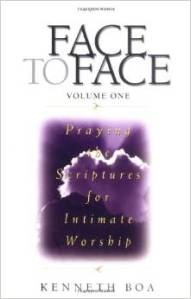
 

Boa Image

Gospel-Centered Prayer for Church-Wide Renewal

Strategies for church growth and revitalization line the walls of Christian book stores. The methods vary as much as the stories that highlight them. Pragmatism is king in our society, and pastors tend to fall prey to this along with everyone else. Despite this tendency, many of these books are legitimately helpful and provide inspiration and insights for ministry. This post isn’t meant to be a bashing of church growth material, for while the materials can be a mixed bag, much good can be gained when read with discernment. The major problem with church growth material is not the content itself but the reader. Strategies are useful and even needed, but if this is where we begin, we have failed from the outset.

Church revitalization begins on our knees in prayer.

Martin Luther understood this well: “If I fail to spend two hours in prayer each morning, the devil gets the victory through the day. I have so much business I cannot get on without spending three hours daily in prayer.”

But we know this not because I say this or Martin Luther claims it, but rather because God promises renewal if we pray.

If my people who are called by my name humble themselves,and pray and seek my face and turn from their wicked ways, then I will hear from heaven and will forgive their sin and heal their land.

-2 Chronicles 7:14

When our churches fail, when we stumble–even run–into sin, and when we grow cold in our love for Jesus, God calls us not to get to work but to come to Him. Why is it that we point people to grace for salvation and again as they fail individually, but when we are faced with a dying church that we immediately turn to the work we can do? God promises holistic renewal for our churches if we would devote ourselves to prayer not because our labor in prayer is a worthy work, but because prayer is a return to the Gospel.

2 Chronicles 7:14 clearly portrays God’s call to Gospel-centered prayer for the sake of renewal. Each act in this verse finds its beginning in prayer and gives us the clear shape of what our prayers should look like. Humbling ourselves begins with prayer to God exhibiting reliance upon him. Seeking God’s face begins with prayer that seeks a right relationship with God. Finally, turning from our wicked ways begins with prayer that turns our hearts toward God and away from sin.

Prayer is the most fundamental Gospel practice, and it’s the Gospel that is the power of God for salvation. As seen in this passage, prayer is fundamental because it exhibits three primary responses to the Gospel:

  1. Reliance – we admit and seek total reliance upon God.
  2. Right Relationship – we put idols aside and seek the face of God through the work of Christ.
  3. Repentance – we turn from sin by the grace of God.

So why does God call his people to prayer in order to experience renewal? Because biblical prayer drives us to meditate upon, experience, and practice the gospel in our lives.

Church revitalization begins on our knees in prayer. To begin anywhere else is to trust in something other than the Gospel. Will we devote ourselves to prayer or place our hopes in someone else?

Hope for Revitalization

Many people look around at the American church landscape and find much to be discouraged about. When 3,500 – 4,000 churches close their doors every year, finding glimmers of hope can be difficult.

If that’s true, why would I even begin to devote myself to helping dying churches recover? Why am I so passionate, so hopeful for churches throughout this country and beyond?

One truth: We are the church of the LIVING God (1 Timothy 3:15).

As Dr. Harry Reeder points out, this truth comes in the midst of what is practically Paul’s manual on church revitalization. Considering the difficulties of this ministry, Paul gives Timothy this great truth in order to ground his hope for the task at hand. While the church is undergoing trials and attacks from Satan in the form of false teachers, Timothy can rest in the fact that God is alive and well.

Praise God, we have this hope as well!

Jesus Christ is the sure foundation for the Church, and he rose from the dead to rule eternally over this world and specifically his Church. His faithfulness remains true, His power remains infinite, and His grace remains abundant.

We have hope as we seek to revitalize dying churches not because of good strategies (although, these are needed), but because God is living and active. May we find hope in our LIVING God and trust that as we lead our churches to abide in Him, our churches shall live as well.

The Bride of Christ

Husbands, love your wives, as Christ loved the church and gave himself up for her.

-Ephesians 5:25

The Church – the people of God – is Christ’s beloved. He sacrificed His entire life that she might have abundant life. He didn’t do this because she was beautiful, lovely, or worthy. Instead, He died for her because He abounds in outrageous grace and love, and He continues to love her despite all her blemishes, no matter how big or glaring they are.

Every individual local church-even with all her failures-is a specific manifestation of the bride of Christ, and He loves and died for each of them.

It’s easy to hate on churches. Unfortunately, unfaithfulness often abounds, and they practically paint big red targets on their backs just asking to be criticized and tossed to the side. But if Jesus loved his people before they ever looked anything like Him, how much more should we as fallen, broken individuals continue to love His bride and fight for her good.

Thousands of churches throughout North America are sick and dying, and we could easily run away hoping to avoid getting caught in the wake. But instead, let us love the Church and the local church with the same grace, mercy and patience as Christ has. Let us be willing to lay down our lives that our churches might thrive again.

This blog, in addition to being a place to encourage and strengthen my own church, serves as a resource for this very task: church revitalization. My prayer is that through the posts and discussions on this blog, pastors and church members would be emboldened to sacrificially pursue renewal and health in their churches with the same passion as our Savior.

The Community of Hope

One of the deepest longings of humanity is that of reconciled, authentic community. Yet, everywhere one turns deep-seated chasms separate people across national, racial, political, and various other divides. Can anything bridge the gaps and heal the wounds caused by these divides? Gazing upon our world provides little hope.

Yet, hope does exist in abundance, just not in the world around us. Instead, it lies in one who entered our world—Jesus. He alone has provided  hope in our broken, corrupt world. Scripture says that Jesus made peace by the blood of his cross. Through his work and the free gift he offers us, we can have reconciled community with God through faith in Jesus. This reconciliation, this salvation, also brings us into reconciled community with others who have faith in Him. When Jesus saves us, he doesn’t leave us as individual Christians, but he makes us part of a community: the church.

Though full of broken people in constant need of grace and forgiveness, the church is the one community with true hope of lasting reconciliation, peace, joy, and love across all cultural, racial, and political bounds. Jesus and his Gospel are the one hope we have for true community.

And it’s that community—the church—that I have grown to love deeply even in light of her warts and scars. This community is the people Jesus loved to the point of death millennia ago. And it’s this community that I am seeking to love in the same way. Following Christ’s example, I long to love and strengthen the church for the fame of Jesus. This blog is devoted to that purpose, and I’ll accomplish that in three ways:

1. Scripture Reflections – Providing meditations and direction for small group discussion
2. Equipping Resources – Providing a wide variety of helps for living this Christian life
3. Church Revitalization – Providing research, insights, and reflections upon an ever-growing passion of mine and an ongoing, yet oft neglected need in churches everywhere

*The first two will primarily be oriented toward my congregation, but I hope they will be a benefit to all who read.