Living as Exiles

After many cycles of disobedient kings in Israel, God sent judgment, and the people of Israel became exiles under the rule of the Babylonian empire. God would eventually rescue his people once again, but until then, he called his people to live for his glory where they were. According to 1 Peter 2:11-12, as God’s people, we are now exiles, too. So we can learn a great deal from Israel during this time. But what does it mean for the church to be exiles, and what are its implications?

As exiles we are called to a…

1. Pilgrimage – As God’s people, this world is not our home. We are journeying through this life to a time when brokenness will be no more, and we will dwell with God forever. Our hope is not in what this world has to offer. So as exiles, we must keep our sights set upon our future dwelling place with God, and we do that by living for things that last beyond this life. We shouldn’t become consumed with material things, accomplishments, or fame, but instead, we focus upon bringing glory to God and sharing the hope of the Gospel with others.

2. Stewardship – As God’s exile people, we must be careful not to allow our focus upon our future home cause us to disregard the stewardship we have been given while we live in this world. We must not simply bide our time in this world as we wait for the next, but just as God called the Israelites to work for the good of Babylon while they were exiled (Jeremiah 29:7), we are called to work for the good of our cities.

Stewarding the resources we have been given for the good of our cities through building, sharing, serving, and engaging culture is part of what we’ve been made to do. As image bearers of God, we are called to create and have been sent to make culture as a reflection of our creative God. And not only will our stewardship for our cities’ good be for God’s glory, but it will also be for our good according to Jeremiah 29:7.

May we be a people that strike the balance of being on a pilgrimage and bearing a stewardship for the fame of Jesus in our city.

***To wrestle with this some more, I’d encourage you to spend some time reading and meditating upon the life of Daniel as well as Jeremiah 29:1-14.
The Creep of Idolatry

Continuing through the story of Scripture after Solomon, the Kingdom of Israel splits into two. The next several hundred years are generally consumed with faithlessness and idolatry in various forms often stemming directly from the leadership of the kings. While we may not bow down to physical idols, we can learn a great deal about how our hearts tend toward them through a few passages in 1 Kings.

In general, idolatry doesn’t overwhelm us in one fell swoop. Instead, we fall to the creep of idolatry in our lives. Little by little, idols vie for more of our hearts’ loyalty. It’s like a bad smell that creeps in over time in your apartment. You may never even recognize it until someone comes over and its full power knocks them over. Idols creep in over time and we need God’s Word and His people expose them in our lives.

Three kings—Jeroboam, Asa, and Ahab—give us some insight into how idols may be hiding in our lives.

1. Rationalized Idolatry (1 Kings 12:25-33)

Having just become king over the newly formed split kingdom of Israel, Jeroboam is feeling the intense pressures of leadership. He had actually been called by God to lead this newly formed kingdom, so the weight of responsibility he felt was probably crushing at times. In order to lead the people of this new kingdom well, he believed they needed a place to worship God that was disconnected from the kingdom of Judah in Jerusalem. So he built places of worship and setup golden calves… big mistake. But how did it come to that point?

Jeroboam had rationalized that his calling to lead from God required this action or he would fail at what he was called to do.

How often do we find ourselves rationalizing sin, specifically idolatry, due to our “calling”?

2. Oblivious Idolatry (1 Kings 15:9-15)

Sometimes we become so caught up in the way things have always been in our culture or in our churches that we are completely unaware of the idolatry that is going on around us or we are actually joining in ourselves. This seems to be what happened to Asa. When he came to power, tons of reforms needed to happen, and overall, Asa did a great job leading the people back to the Lord. Yet, some of the high places remained (these were places of worship out of line with God’s intention). Since Scripture says that Asa followed God faithfully, the high places don’t seem to be an area of intentional sin but rather blindness.

Asa was oblivious to this vestige of idolatry continuing in his country because it had become so commonplace.

What idols or sins have become to commonplace that you are oblivious to their existence?

3. Ambivalent Idolatry (1 Kings 18:21)

Finally, in one of the most famous encounters between a king and a prophet—Elijah and the prophets of Baal—Elijah calls out the ambivalence of King Ahab and the people of Israel. They were “limping between two different opinions.” They tried to serve both God and Baal. The problem is, as Jesus points out in the Gospels, we can’t serve two masters. Going back and forth is not an option.

What idol in your life causes you to waver from following God?

The creep of idolatry is real and subversive. Will you recognize it in your own life and fight back against it for the sake of wholehearted commitment to Jesus?

Three Keys to Spiritual Renewal

Diving back into the Old Testament storyline this week, we find ourselves listening in on God’s words to Solomon after the dedication of the temple.

God knew his people would rebel and need to experience renewal, so he lays out the path to renewal in 2 Chronicles 7:14.

If my people who are called by my name humble themselves, and pray and seek my face and turn from their wicked ways, then I will hear from heaven and will forgive their sin and heal their land.

Prayer is the primary vehicle that God provides here for our spiritual renewal, for later he promises to hear our prayers. Yet, God calls us to a particular type of prayer. Prayer that is characterized by:

Reliance
We are tempted to work ourselves out of problems. Instead, we are called to begin with prayer, thus recognizing that we don’t have the solution in ourselves i.e. humbling ourselves. As a result, God gets the glory, not us. And we experience the renewal that comes from relying upon an all-sufficient God.

Right Relationship
We are tempted to relate wrongly to God: to feel entitled or to pursue other things as ultimate. But God wants us to commune with him, to seek his face, not because we think we deserve it and not because we want other things but because we long to relate to him. So we’re called to go to him in prayer out of a desire to know and be known by him.

Repentance
We are tempted to avoid acknowledging our sin, God’s holiness, and our need for him. Prayer brings us face to face with a holy God which brings our brokenness to light, too. Prayer that truly encounters God leads us to grapple with our sinfulness. Yet it doesn’t leave us in a broken state, for it’s in this repentance that God promises to bring renewal.

May these aspects characterize our prayer that we might experience renewal from our God.

***One last thing: don’t make the mistake of thinking this is always an individual pursuit. Sometimes the start of this process doesn’t begin by yourself before God, but by admitting your struggle to others (humbling yourself) so that they can seek God’s face for you when you feel too weak to do so. This is a huge part of why the church is so vital to our spiritual lives.

What Just Happened?!?

Every good story needs a problem, right? Well, the Bible doesn’t take long to get right to the crux of things. After such a good start, everything seems to fall apart in one fell swoop.

In Genesis 1-2, we see a beautiful, good creation cared for by the powerful, yet personal God of the universe. Beginning in chapter three, everything goes wrong. The one boundary God set for humanity is questioned and undercut by the serpent, and Adam and Eve embrace the lie and seek to be like God—incredibly foolish considering they had already been created in the image and likeness of God. The boundaries were for their good, and having crossed them, the first couple experienced the tragic consequences that we still feel today.

Let’s briefly look at three things we learn from this passage:

1. The nature of temptation
Temptation strikes at our belief in God’s goodness. When we are tempted, we begin to question whether God’s Word is actually intended for our good. This is what happens to Eve. The serpent convinces her that God is forbidding something for no good reason. How often do we fall into that trap?

Our society constantly questions the validity of God’s commands in Scripture. For instance, God makes clear that sex outside of marriage is sin and outside of his plan for us. But how often are arguments made that “making sure you are sexually compatible is important,” or “if I know I’ll be with this person for the rest of my life, then why wait for something that is good?” These objections are questioning the goodness and validity of God’s command. Temptation leads us to ask “Is it really that big of a deal?” Sometimes, it may be hard for us to see why it is, but if we really believe in the goodness of God, then we’ll trust his Word and flee temptation.

In what ways are you doubting God’s goodness in your life right now?

2. Our Reaction to Sin
What happens when we do sin? First, our reaction to sin, especially when we recognize the wrong, is a fleeing from relationships. Sin breaks our relationship with each other and God. As Adam and Eve, we feel shame and guilt, and we begin to experience a breaking of life-giving relationships. We begin to hide parts of ourselves from others, and as the level of authenticity breaks down, our relationships slowly become less and less meaningful. The community we were meant to experience erodes.

Additionally, we begin to flee from God. We don’t want to encounter his Word because we don’t want our sin exposed. We want to hide it from both God’s and our own eyes. So our relationship with Him breaks down.

3. The Response of God
Yet, the truth is, God sees our sin despite our best efforts to hide it, and He justly punishes it as we see in this passage.

But the incredible truth is that He also shows grace. Even in the midst of harsh consequences, God sows seeds of hope and grace. He points toward the promised Savior, who will crush the serpent’s head, ultimately destroying evil and sin. Then he provides a covering for the shame of Adam and Eve. God knows we can’t cover or remove our guilt and shame, so he made a way to wipe away our wrongs. Jesus came and lived the perfect life we were all created for, and then he died to take on the punishment we all deserved. Even in this terribly dark turn in the story, God has sown seeds of light and life!

How is sin breaking down relationships in your life? Do you have a broken relationship with God? If so, admit your sin to Him and trust in his grace that he has given once and for all through Jesus’ work on the cross

***Another Big Question: If God is good and created all things good (as is seen in Genesis 1), why is there so much evil and suffering in the world? Here are two short articles that begin to address that issue:

     –Do Tummy Aches Disprove God by Joe Carter
     –When Atheists are Angry at God by Joe Carter
     -Also, you can check out The Problem of Pain by CS Lewis here.

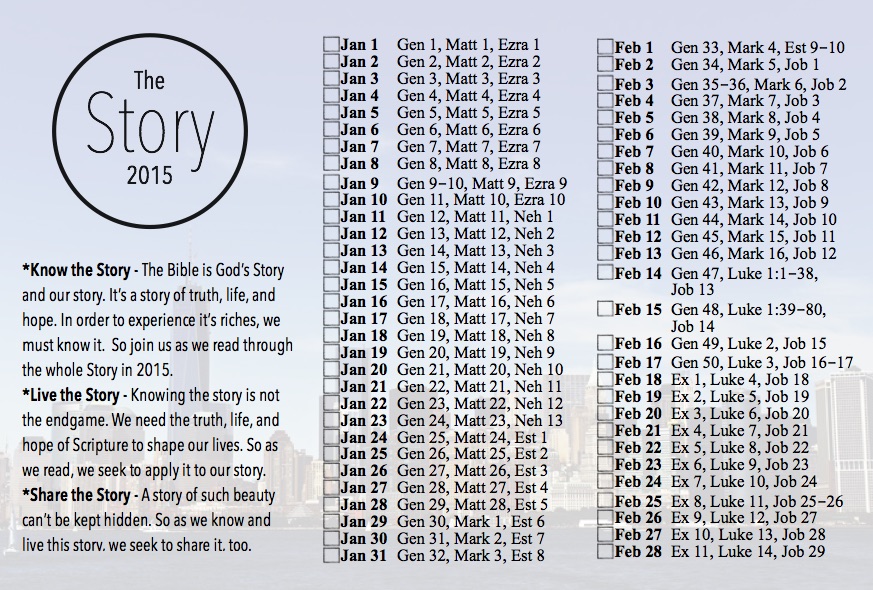
The Story 2015

As we prepare for a new year, it’s a great time to refocus and develop a clear plan for reading Scripture. One of the most fruitful disciplines in my life is reading through the entirety of God’s Word. Seeing the entire story of Scripture come together as a whole can only happen as we read the Bible in its entirety.

Thus, this upcoming year at Gallery Church, we are going to read through the entire Bible together.

The Story 2015

Know the Story – 
The Bible is God’s Story and our story. It’s a story of truth, life, and hope. In order to experience it’s riches, we must know it.  So join us as we read through the whole Story in 2015.

Live the Story –
Knowing the story is not  the endgame. We need the truth, life, and hope of Scripture to shape our lives. So as we read, we seek to apply it to our story.

Share the Story –
A story of such beauty can’t be kept hidden. So as we know and live this story, we seek to share it, too.

Check out the first two months of the plan below:

Story Postcard

Shaping & Sharing Your Story

On Monday, we considered the power of story both in our culture today and in the story of Paul in Acts 26. I encouraged everyone to consider how you would share your own personal story in order to communicate the Gospel. But many of you may be at a loss as to how to share your story in a clear way.

So, here’s a resource from InterVarsity. This tool provides questions to spark your thinking about how to shape and share your story. It hits the same basic plot points that I discussed on Monday: life before Jesus, how you met Jesus, life with Jesus.

Check it out if you need help shaping your story, and pay close attention to their advice at the end: Keep your story short so it’s easy to tell. You can always expand on something when people ask questions.

 30 Minutes to a Shareable Testimony Worksheet